Your Top Workforce Management Questions, Answered

Figuring out what’s best for your contact center can be one of the most difficult tasks, especially when there are so many factors to filter through in staffing operations. Even so, you deserve to know exactly what’s happening in your contact center – and having the right solution, such as TCN’s Workforce Management (WFM), is crucial to finding that out.
In this blog, get answers to your top questions about workforce management and learn about why TCN’s WFM is the best option for your organization.
What is workforce management?
Workforce management is the discipline of planning your work and then executing on that plan. It consists of four key interactive steps: forecasting, scheduling, adherence management and reporting/analysis – all aimed at getting the right people in the right place at the right time to service customer interactions while meeting business objectives.
Why should clients use TCN’s WFM?
Managing all the inputs, metrics and variables that affect planning and performance can be daunting, even for the most seasoned contact center leaders. TCN’s contact center WFM automates the process of leveraging contact history to project future volume (forecasting), building schedules to align resources with volume patterns (scheduling) and comparing scheduled staff to forecast requirements, allowing users to identify future gaps in coverage and take action before they feel the impact.
What is the ROI of WFM?
Initially, TCN’s Workforce Management solutions save time by automating manual processes, including data collection and analysis, forecasting and scheduling. But that’s not all – clients will also gain value because implementing WFM applies strategic governance to each part of the contact center management process:
- Accurate forecasting & optimized scheduling
- Ensures businesses are aware of and able to manage workload fluctuations, whether monthly, weekly, daily or intraday.
- Enables businesses to identify and address gaps created by planned absences/time off.
- Improving planning and visibility helps leaders avoid understaffing or overstaffing, saving time and labor dollars.
- Improved adherence
- Consistent visibility into agent activity and notifications that do not align with scheduled activities significantly reduces call avoidance behaviors.
- Decreased pause or idle time
- Adherence reporting makes overall pause code usage more visible, allowing leaders to identify and address unproductive behavioral patterns. Decreasing pause time increases productive time, allowing agents to take more time off or schedule offline time and providing clients with opportunities to reduce staff to lower overall labor costs.
How do I access WFM?
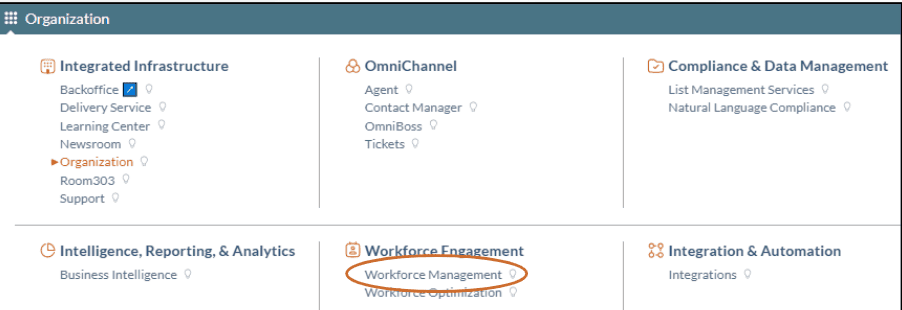
WFM can be accessed directly from the TCN Operator interface by clicking the candybox button in the top-left corner of the Operator screen, then selecting Workforce Management from the Workforce Engagement section of the application list.
What features are currently available in WFM?
Currently, the Forecaster, Scheduler, Adherence, Manager Portal and Agent Portal modules are available. Each of these modules will continue to evolve through a combination of planned enhancements and client feedback.
What is a Skill Profile?
WFM automatically imports existing call and agent statistics from Operator and organizes them into Skill Profiles. These Skill Profiles are the foundation of all forecasting and scheduling.
Users can view Skill Profiles for their organization by accessing the Forecaster menu on the left-hand side of the WFM screen and clicking on Skill Profiles. Each Skill Profile for the organization will be listed along with associated information, including the Skill Profile name, associated skills, occurrence percentage and performance statistics such as ATT, ACW, ASA and ATAB.
How does TCN’s WFM create a forecast and calculate the required staff for scheduling?
TCN’s WFM Forecaster employs a hybrid forecasting approach that integrates traditional time series and qualitative forecasting techniques. Historical averages serve as a foundation, augmented by the ability to account for contextual variables.
Additionally, within Operator, Forecasting Parameters allow users to specify how much history to consider, and the Profile Forecasting Model allows the incorporation of contextual variables – such as planned marketing campaigns or qualitative expert input – ensuring forecasts reflect both historical patterns and real-world business dynamics.
TCN’s WFM Scheduler then uses advanced AI to enhance the accuracy of workload requirement calculations. Our algorithm combines traditional Erlang formulas with powerful simulation technology to examine historical intra-interval distribution patterns specific to each unique contact type.
Users can also incorporate customizable targets such as service and coverage objectives, agent preferences and scheduling rules. This detailed analysis enables precise planning for both single-channel and omnichannel environments, ensuring that the right number of people are in the right place at the right time for every interaction.
How far in advance should schedules be built and published?
There is no one-size-fits-all answer for all clients. How far in advance schedules are built and published will depend on existing scheduling processes and expectations.
Organizations will need to consider their current scheduling timelines (how far in advance they provide schedules, how they handle time-off requests, how holidays are handled, etc.) and then determine whether any of those processes will change with the implementation of WFM before determining a scheduling cadence within TCN’s WFM.
Do you still have questions about contact center Workforce Management software? Request a demo with a product expert and get a custom walkthrough of how WFM can specifically help your contact center!